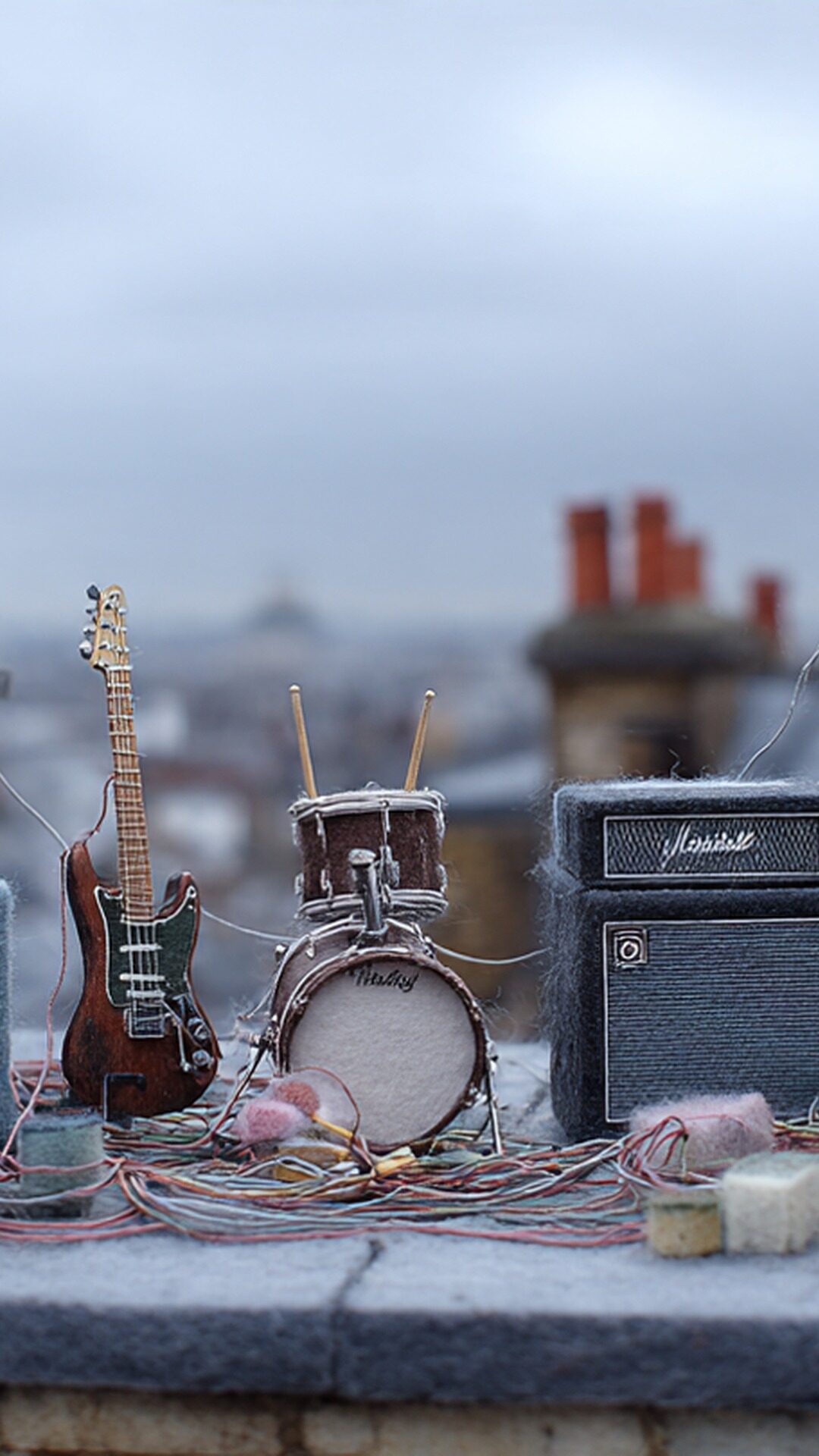
Let It Be
LP by The Beatles • 8 May 1970 • Parlophone PXS 1
Let It Be (1969–70) — Rooftop chill, gold-on-black valedictions.
★ Extended editorial essay (5 sections)
Essay sections
Listen on Spotify
The full album on Spotify (1970-05-08, Remastered). Sign-in Spotify users get complete playback; non-signed-in visitors get 30-second previews of every track. Open in Spotify →
Overview
Let It Be is the twelfth and final studio album by the English rock band the Beatles. It was released on 8 May 1970, nearly a month after the official announcement of the group's public break-up, in tandem with the documentary of the same name. Concerned about recent friction within the band, Paul McCartney had conceived the project as an attempt to reinvigorate the group by returning to simpler rock 'n' roll configurations. [Wikipedia]
Where they were
The album that closes the canon is the album that was begun first. Most of Let It Be was recorded between 2 and 31 January 1969 as part of the 'Get Back' project — a return-to-roots attempt to make a live-feel LP filmed for a TV special. Twickenham Film Studios served as a freezing rehearsal hangar for the first ten days; sessions then moved to the Beatles' newly-built Apple Studio in the basement of 3 Savile Row. The famous rooftop concert on 30 January 1969 was the last time the four Beatles played publicly. Phil Spector was brought in by Lennon and Harrison in March 1970 to overdub strings, brass, harp and choir — to McCartney's lasting fury.
Release context
Let It Be is a Beatles EP issued in the United Kingdom on 8 May 1970 by Parlophone under catalogue number PXS 1. It sits in the band's Let It Be (1969–70) period. It was issued the same day as the parent LP Let It Be.
Sessions were produced by George Martin (sessions); Phil Spector (post-production overdubs March/April 1970) with Glyn Johns, Phil McDonald (sessions); Peter Bown, Phil Spector engineers (post) engineering, working at Twickenham Film Stages (Jan 1969). The signal chain ran through the Studer J37 8-track at Apple • Custom Apple/Helios console (heavily problematic), later EMI TG12345, with vocals captured on U47, U67, AKG C12, AKG D19, AKG D20. This combination of room, tape format and outboard chain is the same one heard across the band's other releases from the era — meaning the release shares its sonic identity with its parent LP rather than departing from it.
The release features Two of Us, Dig a Pony, Across the Universe, I Me Mine, Lennon–McCartney–Harrison–Starkey, Let It Be ★, Maggie Mae.
Documented alternate masters and remaster passes can be found via the linked entries above; the editorial position throughout Beatles Answers is that the original UK mono master is the canonical point of reference for any EP from this era, with the 2009 and 50th-anniversary stereo remasters treated as documented variations rather than replacements. Catalogue numbers, label copy and matrix data are taken from EMI/Parlophone primary documentation and cross-checked against Mark Lewisohn's The Complete Beatles Recording Sessions (1988).
Recording
The Twickenham sessions were attempts to rehearse new material for a planned live show; they produced no usable masters and almost no morale. The Apple basement sessions, with Glyn Johns engineering and Billy Preston playing electric piano, produced most of the released album. Spector's post-production at EMI in March/April 1970 added the orchestral and choral overdubs that have divided opinion ever since — McCartney's lawsuit against the other three the following December cited the Spector mix of The Long and Winding Road as a contractual betrayal.
The songs
Get Back closed the rooftop set with Lennon's famous 'I'd like to say thank you on behalf of the group and ourselves and I hope we passed the audition.' Let It Be was inspired by McCartney's dream of his late mother Mary visiting in a time of trouble. Two of Us is a McCartney song about Linda that feels — and was sung — like a valediction to his songwriting partnership. I Me Mine, recorded on 3 January 1970, was the last new song the band ever cut as a group (Lennon was in Denmark and absent from the session). Across the Universe, originally cut in February 1968, was rescued for Spector's strings-and-choir treatment.
Reception
Released 8 May 1970, a month after McCartney announced his departure. UK number one for three weeks. Reviews ranged from dismissive (the NME called it 'a sad and tatty end to a great career') to defensive (Lennon, in 1971, said it was 'the shittiest load of badly-recorded shit'). McCartney's 2003 Let It Be… Naked stripped Spector's overdubs back off, providing for the first time the LP as the band had originally intended it.
Legacy
Let It Be is the awkward postscript that was meant to be the warm centrepiece. Its rooftop concert remains one of pop's most-screened sequences. The album's release in May 1970 ended the public phase of the band; the lawsuit between McCartney and the other three would last until 1975 and end with Apple Corps still standing, the Beatles partnership finally dissolved.
What's distinctive
12 tracks; average length 2:55. Lennon dominates the lead vocals (7/12). Lead writing credit: Lennon–McCartney (5 of 12). Includes 2 solely Harrison-credited compositions. 1 marquee song(s) on this release have hand-crafted extended essays. Estimated total takes across the release: 275.Tracklist
Side A
- Two of Us
- Dig a Pony
- Across the Universe
- I Me Mine
- Lennon–McCartney–Harrison–Starkey
- Let It Be ★
- Maggie Mae
Side B
Pattern analysis
Era technical context
| Microphones | U47, U67, AKG C12, AKG D19, AKG D20 |
|---|---|
| Outboard | Apple's hand-built outboard (faulty), then EMI standard kit; Spector added strings/choir at EMI March 1970 |
| Guitars | Fender Rosewood Telecaster (Harrison), Gibson Les Paul 'Lucy' (Harrison), Hofner 500/1 (McCartney returned), Epiphone Casino (Lennon), Höfner Hofner Beatle bass + Fender VI bass (Lennon on rooftop) |
| Amplifiers | Fender Twin Reverb, Fender Bassman, Vox UL730, Hammond C3 / Fender Rhodes (Billy Preston) |